
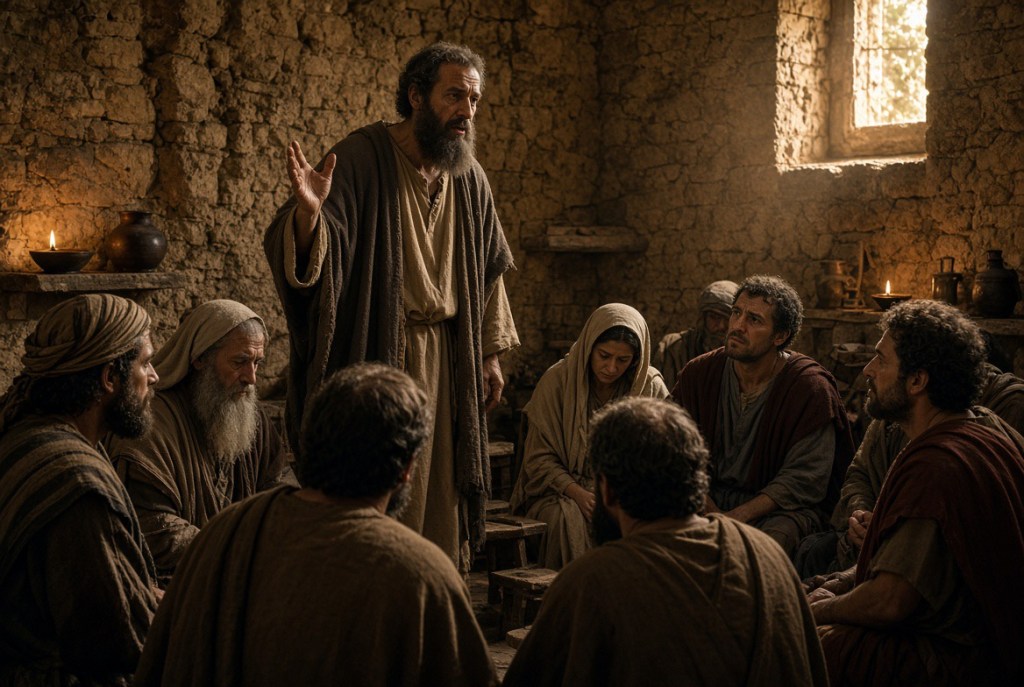
Romans 2:12–16
In the last part of this series Paul has shown that God judges impartially and according to works. He has stripped away the refuge of moral comparison and the false security of religious privilege. Now he presses further into a question that inevitably arises: What about those who never received the Law? What about those outside the covenant, outside Scripture, outside the visible people of God? Does less light mean less accountability?
In Romans 2:12–16, Paul confronts one of the most common assumptions held by both religious and non-religious people: that accountability is determined primarily by how much religious knowledge a person has been given. He dismantles that assumption completely. God does not judge based on the amount of light a person possesses, but on how they respond to the light they have been given.
This passage is deeply humbling. It removes every excuse for pride; whether religious or secular. It shows that God’s judgment is not arbitrary, cultural, or unfair. It is rooted in truth, conscience, and divine knowledge of the heart. At the same time, it prepares us for the gospel by exposing a reality we would rather avoid: no one lives up even to the standard they already know.
“For all who have sinned without the Law will also perish without the Law, and all who have sinned under the Law will be judged by the Law.”
Paul divides humanity into two broad categories: those “without the Law” and those “under the Law.” In his context, this primarily refers to Gentiles and Jews. But the principle reaches further. He is addressing people with different degrees of revealed knowledge.
The key word is “sinned.” Paul does not say “all who lacked information.” He says “all who have sinned.” Sin, not knowledge, is the decisive issue. Accountability is universal because rebellion is universal.
Those who sin without the Law will perish without the Law. This does not mean they are excused. It means they are not judged by a standard they were never given. God does not condemn people for failing to obey what they never received. But neither does ignorance cancel guilt. Sin still brings death.
Those who sin under the Law will be judged by the Law. Greater revelation brings greater accountability. To possess God’s commands is not protection; it is responsibility. Knowledge increases exposure, not immunity.
God’s judgment is perfectly proportioned. No one will be judged unfairly. No one will escape accountability.
“For it is not the hearers of the Law who are just before God, but the doers of the Law will be justified.”
Here Paul strikes at the heart of religious presumption. Hearing the Law refers to regular exposure: listening to Scripture read, taught, discussed, and admired. For the Jews of Paul’s day, this happened weekly in the synagogues. For many today, it happens through churches, sermons, podcasts, books, and Bible studies.
Paul’s point is simple and devastating: hearing is not righteousness.
To be “just before God” is courtroom language. It means being declared righteous in God’s sight. Mere exposure to God’s Word does not accomplish this. What matters is obedience.
We must be careful, however. Paul is not teaching salvation by works. If perfect obedience to the Law could justify, Christ would be unnecessary; and Paul will soon make clear that no one keeps the Law. What he is doing is closing a loophole. He is stripping away the false confidence that religious participation equals spiritual safety.
This verse exposes a tragic irony: the people who most frequently hear God’s Word are often the most tempted to confuse familiarity with faithfulness.
“For when Gentiles who do not have the Law naturally do the things of the Law, these, not having the Law, are a law to themselves, in that they demonstrate the work of the Law written in their hearts, their conscience bearing witness and their thoughts alternately accusing or else defending them.”
Paul now turns to those without the Mosaic Law and explains why they remain accountable. Gentiles may not possess the written commandments, but they are not morally blank.
When Paul says they “do instinctively the things of the Law,” he does not mean perfect obedience. He means that even without Scripture, people recognize moral obligations: honesty, justice, restraint, fidelity, responsibility. These instincts reflect something deeper.
The “work of the Law” is written on their hearts. This is not the Law itself in its full Mosaic form, but the moral imprint of God’s character embedded in the human conscience. It is part of what it means to be made in the image of God.
Conscience functions as an internal courtroom. It bears witness. It accuses. It defends. People argue with themselves, justify themselves, and condemn themselves. This internal moral dialogue reveals that humanity knows right and wrong, even when it resists that knowledge.
No one truly sins in complete innocence. Suppression may be strong, but the knowledge is real.
“on the day when, according to my gospel, God will judge the secrets of men through Christ Jesus.”
Paul brings the argument to its climactic point. Judgment is not only future; it is personal, penetrating, and unavoidable.
God will judge “the secrets of men.” This moves beyond outward behavior into inner reality: thoughts, motives, intentions, desires, and rationalizations. The public self and the private self will be fully exposed. Nothing remains hidden.
And notice how God judges: through Christ Jesus. Jesus is not merely the Savior; He is also the Judge. The One who bore judgment is the One who will render it. This ensures that judgment is both perfectly just and fully informed.
Paul says this judgment is “according to my gospel.” The gospel does not erase judgment; it explains it. The cross proves how seriously God takes sin. The resurrection proves Christ’s authority to judge. The gospel declares that judgment has already begun at the cross and will be finalized at Christ’s return.
And so, Christ who invites sinners to come is He before whom every heart will be laid bare.
These truths call for honest examination:
- Where have I been quietly assuming that greater Bible knowledge, regular church attendance, or familiarity with sound doctrine somehow places me in a safer position before God than those with less light?
- When I hear or read God’s Word, am I primarily a hearer who admires truth, or a doer whose life is being reshaped by it? What evidence would someone who watches my private life see?
- In what areas of my life do I still treat knowledge of the truth as a kind of spiritual insulation rather than a call to deeper obedience and repentance?
- How does my conscience typically function? Does it regularly accuse me in ways that drive me to Christ, or do I quickly silence it with self-justification, comparison, or religious activity?
- What “secrets”: thoughts, motives, private ambitions, or rationalizations, would be most painful if they were fully exposed before Christ tomorrow? Am I bringing those into the light now, or managing them in the dark?
- Have I been measuring my spiritual health more by how much I know and how often I hear truth, or by the quiet, consistent fruit of repentance, humility, and love for Christ?
- In what subtle ways might I still be trusting in my religious exposure, moral awareness, or theological accuracy rather than resting fully in the finished work of Christ?
- When I consider that God will judge the secrets of men through Christ Jesus, does that reality produce casual familiarity or holy sobriety in me? Why?
- If all my outward Christian activity were stripped away tomorrow, what would remain of my walk with Christ? Would there still be evidence of a heart that has been claimed by grace?
- Am I living today as someone who will one day give an account for the light I have received, or as someone who assumes that light itself is enough?
- Where do I need to repent of confusing familiarity with faithfulness?
- In light of this passage, what is one specific way I need to respond to Christ afresh; not with more knowledge, but with deeper trust and obedience?
In closing, Romans 2:12–16 dismantles every form of false security. Judgment is not avoided by ignorance, religious exposure, or moral sincerity. God judges perfectly: according to truth, conscience, knowledge, and the heart.
For those who trust in Christ, this passage humbles us. Our standing before God is not based on how much we know, how often we hear Scripture, or how morally aware we are. It rests entirely on Christ. Our obedience does not justify us; it testifies that grace has taken root. Let this passage guard us from spiritual pride and drive us back to daily repentance and faith.
For those not yet trusting in Christ, this passage is both sobering and honest. We are not condemned for failing to know everything, but we are accountable for resisting what we already know. Conscience itself bears witness. And if we are honest, we all fall short even of our own standards.
This is why the gospel is not optional. If judgment were based on information alone, some might escape. But judgment is based on truth; and truth exposes us all.
The good news is this: the Judge has made a way of escape. Christ, who will judge the secrets of men, first bore the judgment for sinners who repent and believe. On the cross, God judged sin fully and finally so that sinners could be forgiven, cleansed, and made new.
So the invitation of this passage is clear: do not trust in knowledge, morality, or conscience. Trust in Christ.
On that final day, only one question will matter: not how much you knew, but whom you trusted.
And the promise of Scripture remains:
“Therefore there is now no condemnation for those who are in Christ Jesus.” (Romans 8:1)


Leave a Reply